
Air Charter Service opens office in Stuttgart
May 21, 2026 at 9:31 AM
Rhenus activates land corridor via Jordan
May 21, 2026 at 9:47 AM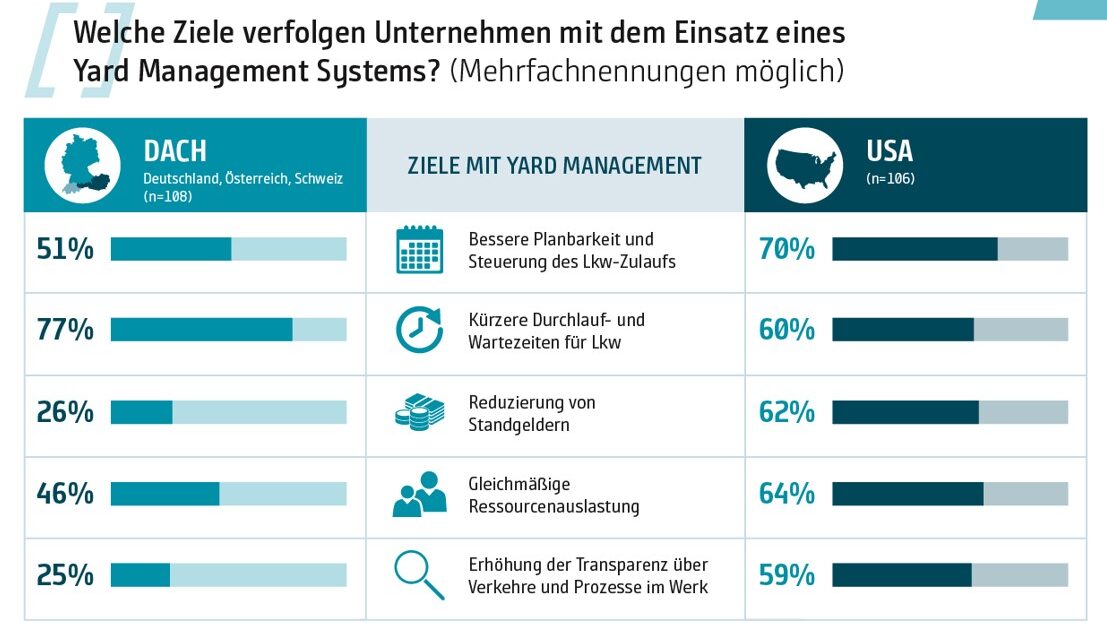
The internationally active AI and optimization specialist INFORM has examined the differences and similarities in yard management between companies from Germany, Austria, and Switzerland (DACH) and the USA in a recent survey. The results show significant differences in delivery processes, challenges, and technological priorities between the two markets.
Delivery Delays in Focus
The survey revealed that no company in the DACH region reports consistently on-time deliveries. More than half of the surveyed companies experience delays in up to 50 percent of transports, while 14 percent report even higher percentages. In comparison, 44 percent of US companies report delays in less than ten percent of arrivals. No company in the USA indicates that more than 50 percent of all trucks arrive late.
The causes of these delays are similar in both regions. Unexpected disruptions in the process are cited by 66 percent of respondents as the main reason. However, internal bottlenecks are more pronounced in the DACH region: 64 percent of respondents attribute this to a lack of personnel or technical capacities, while this figure is 45 percent in the USA. Other issues such as uncoordinated truck arrivals and inaccurate time windows are also considered relevant in both regions.
Digitalization and Its Hurdles
Digitalization in yard management is progressing, but the hurdles differ between the two markets. In the DACH region, 59 percent of companies are already actively using yard management software, while in the USA, the figure is 64 percent. Additionally, 12 percent of companies in the USA plan to implement this technology in the medium term. The biggest obstacles to digitalization in the DACH region are a lack of internal capacities (48 percent) and integration issues (27 percent). In the USA, however, budget restrictions (47 percent) and unclear business cases (39 percent) are more common challenges.
The goals that companies pursue with a yard management system also show differences. In the DACH region, the focus is on operational efficiency: 77 percent of respondents want to reduce throughput and waiting times, while in the USA, alongside better planning of incoming goods (70 percent), reducing storage fees (62 percent) and increasing transparency about processes (59 percent) are also priorities.
Different Requirements for Modern Systems
The requirements for modern yard management systems also vary. In the DACH region, functions that relieve operational daily tasks are prioritized. 65 percent of respondents mention mobile pre-registrations, 63 percent self-check-in functions, and 60 percent the automation of processes. In the USA, however, more interconnected control functions are significant, such as driver communication (66 percent) and interfaces to telematics platforms (58 percent).
The priorities for the next five years also show different approaches. US companies place great importance on mobile usability (77 percent), cloud architectures (75 percent), and AI-based optimization (71 percent). In the DACH region, these values are significantly lower, with 61 percent mentioning mobile usability and 49 percent integration.
Oliver Graf, product manager at INFORM, comments on the results: “Companies in the DACH region and the USA are pursuing different development paths, but in both markets, the importance of reliable yard management is growing. As deliveries, resources, and operational priorities become more dynamic, a shared situational awareness that provides orientation and enables sound decisions becomes increasingly important.”
The survey “How Smart Is Your Yard? Optimization Potentials in Yard Management” was conducted at the end of 2025 and included 214 specialists and executives from logistics, industry, and trade in DACH and the USA. The aim was to comparatively analyze challenges, maturity levels, and development focuses in yard management in both regions.
For more information and the complete study, click here