
German Customs contributes to security in 2025
May 12, 2026 at 4:29 PM
TGW Logistics receives gold at “German Innovation Award”
May 13, 2026 at 8:03 AM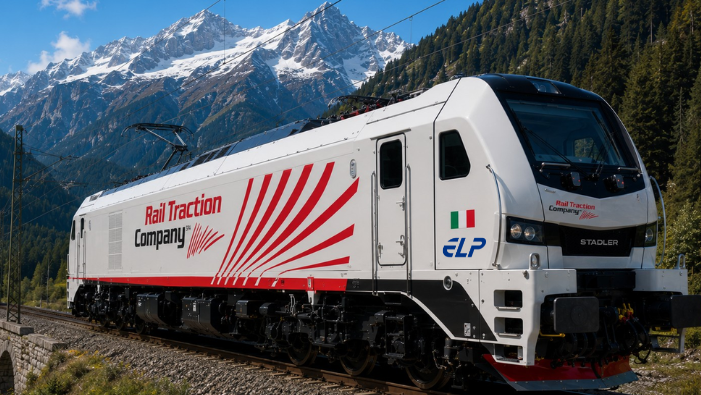
After the successful approval of the Euro9000 for the Italian market, the European Loc Pool (ELP) based in Frauenfeld, Switzerland, in collaboration with the Rail Traction Company (RTC), has commenced the first test runs on the Brenner axis. These tests are part of the practical registration of the multi-system locomotive in Italy and aim to evaluate its performance in the demanding Italian freight transport sector. Additionally, new opportunities for more efficient and interoperable transport solutions between Germany, Austria, and Italy, as well as on the Domodossola route between Switzerland and Italy, will be explored.
The Brenner axis and the Domodossola route are among the key connections in European freight transport and impose high demands on performance and flexibility. With the approval for Italy, the Euro9000 expands its operational range to one of the most important freight corridors in Europe. RTC is one of the first companies to test the Euro9000 in an operational environment. RTC Managing Director Martin Ausserdorfer emphasizes the need for technical advancements and sees potential in the Euro9000 to improve efficiency in train production.
A central goal of the tests is to handle international traffic without additional locomotive changes. The multi-system capability of the Euro9000 allows for operation in several countries, including Germany, Austria, the Benelux countries, and Italy. This creates the conditions for interoperable transport concepts along the entire corridor. Ausserdorfer highlights that the Euro9000 is expected to efficiently transport heavy train weights with just one locomotive, which has previously been partially achieved through double traction.
Technical performance and service quality in focus
In addition to technical performance, the role of a reliable full-service leasing partner is also significant. RTC emphasizes the importance of high availability, quick response times, and solution-oriented collaboration in daily operations. Ausserdorfer states, “The most important thing is the service, accessibility, and the ability to solve problems quickly and efficiently.” Every day a locomotive is not in operation incurs costs.
The Euro9000 was developed not only for international traffic but also to efficiently cover the first and last mile. This enables operators to handle traffic without additional shunting or diesel locomotives while benefiting from high performance on international corridors. Under 3 kV infrastructure, the Euro9000 demonstrates its strengths by providing additional power through the use of the diesel engine as a boost. Willem Goosen, CEO of ELP, explains that this leads to a more efficient and reliable handling of demanding traffic.
Should the test runs be successful, RTC sees potential for the long-term deployment of the Euro9000 in international freight transport. In the future, additional international connections and further European markets could also be tapped. With the approval for Italy and the ongoing test runs, ELP positions itself as a provider of a powerful multi-system locomotive for modern European freight transport corridors. The combination of high performance, multi-system capability, and an additional diesel module allows for flexible operations on both electrified and non-electrified sections.
Goosen adds that ELP is now bringing its three years of operational experience from international markets to the Italian market. He is confident that the Euro9000 will meet RTC’s expectations and set new standards in efficiency and flexibility for European rail freight transport.