
Röhlig SUUS Logistics celebrates 20 years of Beko
May 18, 2026 at 9:22 AM
Kuehne+Nagel becomes logistics partner of MCH Group
May 18, 2026 at 10:27 AM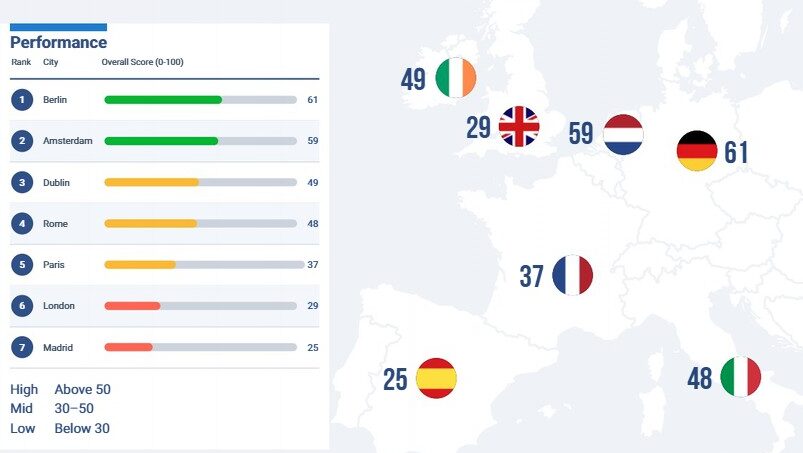
The Canadian technology company Geotab has identified significant differences in freight efficiency across European capitals in a recent report. The „European Freight Efficiency Index“ titled „The Cost of Standing Still“ shows that Berlin has the highest efficiency rating at 61 out of 100 points, while Madrid ranks at the bottom of the scale with only 25 points. This results in a performance gap of 144% between the best and worst cities.
The study highlights that millions of vehicles travel through European cities daily to transport essential goods such as food, medicine, and materials. However, the efficiency of these transports varies significantly depending on the city. The report indicates that even with identical vehicle fleets, efficiency is heavily influenced by the respective urban infrastructure and traffic conditions.
Different traffic conditions and their impact
Berlin benefits from a polycentric urban structure that distributes traffic across multiple routes, allowing for a stable traffic flow. In contrast, Madrid suffers from high congestion susceptibility, negatively impacting efficiency. Amsterdam closely follows Berlin with 59 points, while Dublin (49) and Rome (48) exhibit moderate efficiency. Paris (37) and London (29) fall into a category where traffic conditions adversely affect fleet efficiency.
The analysis shows that not only the volume of traffic but also the predictability of traffic flow is crucial for efficiency. In cities like London, Paris, and Madrid, the unpredictability of traffic is a central issue. This unpredictability leads to a „structural tax burden,“ manifested in the form of additional buffer times and inefficient delivery windows.
Edward Kulperger, Senior Vice President EMEA at Geotab, explains: „Efficiency in urban freight transport has often been viewed solely through the lens of traffic congestion. This index shows that traffic behavior represents a deeper issue. In the most efficient cities, movement is constant and predictable, while in the least efficient cities, it is fragmented, directly impacting costs and emissions.“
Index methodology
The European Urban Freight Efficiency Index rates each city on a scale from 0 to 100, based on two dimensions: traffic flow and congestion costs. Traffic flow accounts for 75% of the rating and considers congestion levels, the number of hours with flowing traffic, and the predictability of travel times. Congestion costs make up the remaining 25% and measure vehicle idling as an indicator of waste generated by the system.
The data for the index comes from the year 2025 and is based on information from Geotab’s connected vehicles in seven cities: Berlin, Amsterdam, Dublin, Rome, Paris, London, and Madrid. The ratings are relative and based on a sample of connected vehicles, not a complete survey.