

Lödige Industries presents “Cargo Direct”
Mar 13, 2026 at 2:34 PM
The supply of goods critically depends on stable supply networks and secure infrastructures. However, profound social, ecological, and technological upheavals increasingly threaten these and disrupt the normal flow of goods, services, and information. To secure and maintain supply chains in the long term, the establishment of resilient, highly agile supplier networks for production and logistics is essential.
By: Robert Recknagel
Supply chains have rarely been as threatened as they are today. Measures such as trade tariffs are disrupting markets, while extreme weather and climate-related raw material shocks threaten global economic growth. „Black Swan“ events, once an exception, are now occurring with alarming frequency, interrupting supply chains with disturbing regularity. Risk factors such as costly rerouting or high insurance surcharges could drive logistics costs to unpredictable heights in the coming years. In the field of artificial intelligence, where systems are becoming increasingly complex and autonomous, the potential for „Black Swans“ is also growing, with previously unforeseen economic, ethical, and societal consequences.
However, with appropriate solutions, a digitized, AI-based, and highly interconnected economy also offers the opportunity to respond quickly and flexibly to changes and to be prepared for the unexpected through proactive planning. To implement this, the economy must digitalize its production, implement technical innovations and regulations, and, above all, make consumer behavior more sustainable.
The „toilet paper crisis“ as an eye-opener
Such requirements can be clearly observed in the so-called „toilet paper crisis“ during the COVID-19 pandemic. Due to the measures taken, an disproportionately high number of people stayed at home, leading to an increase in the demand for toilet paper in households. At the same time, the demand for everyday goods surged to such an extent that the transport vehicles‘ delivery capacities were no longer sufficient to bring all goods to supermarkets in adequate quantities on time. In prioritizing loading goods, items with high volume and low margin were sidelined—this included toilet paper, which was therefore temporarily available in insufficient quantities in stores. This example clearly illustrates the vulnerability of supply chains: a more flexible system could have supplied several different supermarkets with the corresponding critical product groups by utilizing additional trucks. On the production side, bottlenecks arose because plants that produced toilet paper in bulk for companies and organizations could not be retooled quickly enough to manufacture the higher demand for household-sized packages and qualities.
But a lack of resilience was also revealed in production sectors, particularly in the automotive industry. The massive dependencies in distributed value creation networks—such as those on the supply chains of Chinese producers—significantly disrupted the just-in-time (JIT) delivery of essential components. The strategy pursued over the past decades of distributing value creation across the globe—such as assembling entire modules of European car manufacturers in Asia—suddenly worked against its creators.
Creating future-proof resilience concepts
Companies had to realize that their highly integrated global supply networks were too cumbersome to cope with high volatility. A lack of maneuverability makes their supply chains more susceptible to severe consequences from unforeseen events. As a result, resilience has become a central requirement for supply chain operators. The term refers to the ability to anticipate, absorb, and quickly recover from disruptions to maintain business operations.
A new planning approach
To transform static, long-term oriented systems into dynamic, resilient supply chains, a new planning approach is required. Companies must enhance their transport management systems, which ensure transparency in the supply chain, with real-time monitoring of process execution and modern supply chain control tower functionalities. Corresponding software then analyzes the collected information in real time, assesses its significance, and estimates the need for action. By implementing continuous planning funnels across the entire supply chain, an effective tool for dynamic network and route planning is created, significantly improving the efficiency of transport processes and the resilience of the entire supply chain.
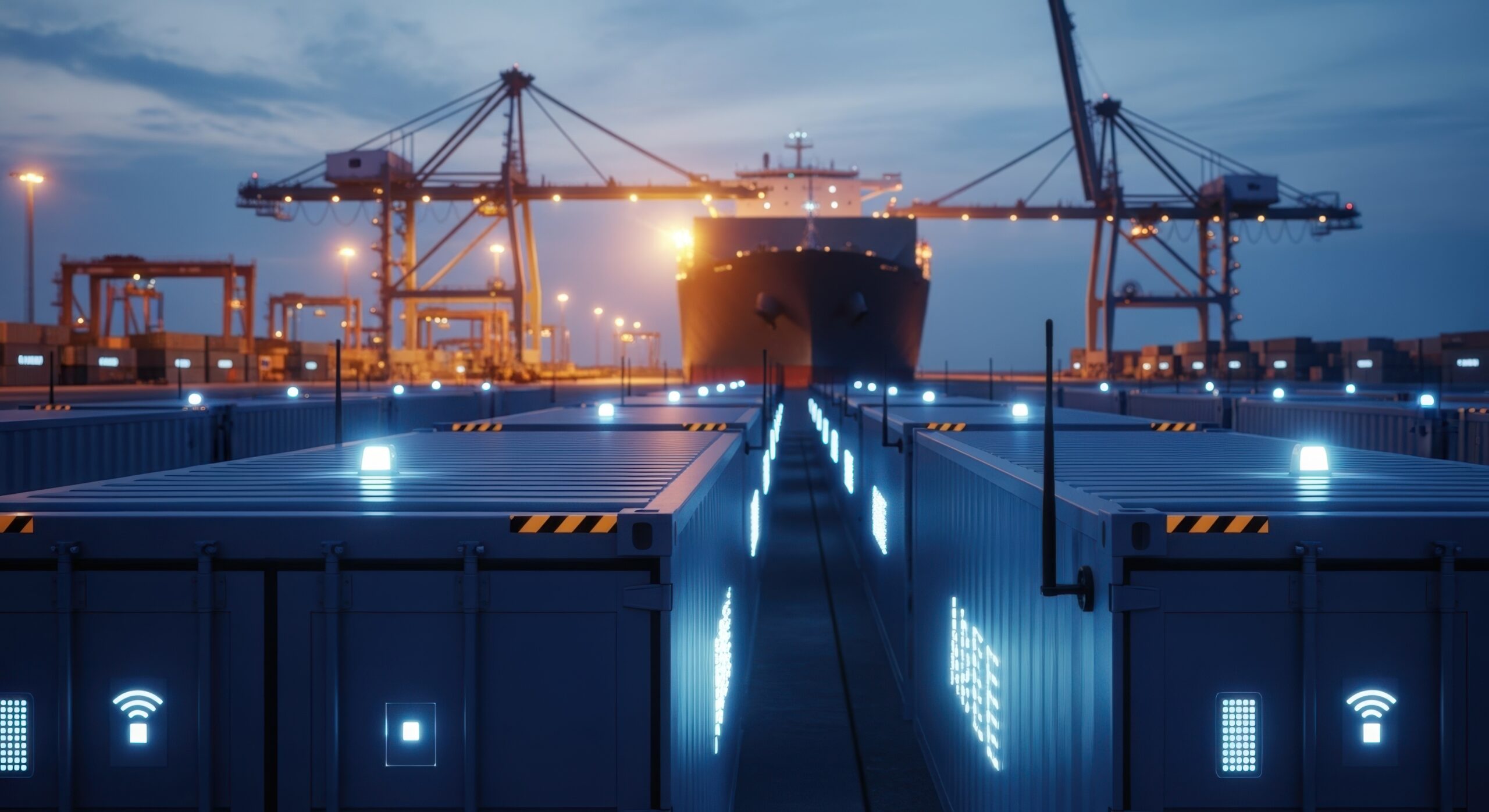
Smart shipping containers equipped with IoT sensors for enhanced supply chain visibility.
Maximum supply chain transparency
To achieve such high reaction speeds, companies need a maximally transparent supply chain that reveals all processes from raw material procurement to the end consumer. Furthermore, this must generate decision-making aids within seconds through data collection and analysis systems and, if necessary, initiate automated measures. This requires not only up-to-date information, such as about alternative transport modes and routes, but also powerful software solutions that can determine and present all implications of alternative decisions in real time, for example, what advantages and disadvantages in terms of lead times exist, what the cost balance looks like, and what consequences the respective decisions will have in the future.
Responsive system landscape
The foundation for a future-proof resilience concept is a responsive system landscape with real-time monitoring of process execution and modern supply chain control tower functions. While transport management systems provide the necessary visibility and process transparency, they are not capable of independently executing further steps and interpreting, for example, the colors of process traffic lights that are red, yellow, or green. This requires platforms that can recognize and integrate current supply chain contexts, which many of the existing platforms are hardly capable of. If a traffic light in the transport management system is red, it makes a difference whether a JIT customer relies on immediate delivery or whether, for example, the delivery date is not critical because the stocks are sufficient or the goods are not currently needed. Whether and what measures need to be taken can be determined with the help of agile software.
Planning funnels along the supply chain
To detect impending bottlenecks and other short-term changes early, companies should establish an integrated planning funnel from the strategic to the tactical and operational perspective, up to real-time scenario considerations. Planned states are continuously validated against operational feedback and provide recommendations for action in case of deviations. For a quick and comprehensive handling of deviations, it is important to prioritize alternative actions in a control tower system.
Using a wealth of real-time data, the system calculates the implications of possible alternative transport options and feeds the results into the control tower application. The customer adds their individual supply chain data, such as end customer requirements, after which the system presents suitable decision-making bases. For example, it may indicate that without immediate action, a critical deadline for a customer will be missed, with potentially serious consequences. Alternatively, the identified problem may not be severe within the customer’s guidelines; a simple call informing that the delivery will be delayed by an hour may suffice.
Dynamic route planning as a joker
Route planning aims to find the most efficient planning for the current situation and minimize the possibility of interruptions. Modern dynamic route planning systems offer the ability to integrate data updates and analyses as well as AI into process control. They adapt flexibly and largely automatically to changing circumstances and reconfigure individual process steps if necessary. Whether it is a traffic situation, weather event, or last-minute changes in the customer’s delivery schedule—the system not only monitors the delivery but also quickly and automatically initiates corrective measures, informs the involved stakeholders, and suggests alternative routes or transport modes.
Deepening digitization with Logistics 4.0 technology
For traditional supply chains, whose planning is subject to long-term strategies, „Black Swans“ pose a constant challenge. However, by implementing continuous planning funnels within all segments of the supply chain, a deeper digitization with modern Logistics 4.0 technology can be achieved, enabling the transition from long-term planned supply chains to resilient, highly agile supplier networks. By integrating real-time data and analyzing it in the planning process, dynamic network and route planning can be realized, significantly increasing the efficiency of transport operations and allowing for the establishment of a stable resilience architecture.

As Head of Operations & Go-To-Market, Robert Recknagel is responsible for sales, implementation, content development, and strategic product development in logistics and manufacturing at Blue Yonder. He advises companies in these sectors on the selection and implementation of IT solutions at the strategic, tactical, and operational planning levels.
Robert Recknagel holds a degree in Service Administration Management from the University of Trier and began his career as a solution consultant in Europe and Southeast Asia. He then implemented international logistics concepts for the automotive, manufacturing, and retail sectors at Rhenus Logistics, laying the foundation for the logistics service provider’s 4PL business.