

Herzog leads Militzer & Münch Switzerland
May 11, 2026 at 9:13 AM
Realterm targets DACH market with Ramasubbu
May 12, 2026 at 7:13 AM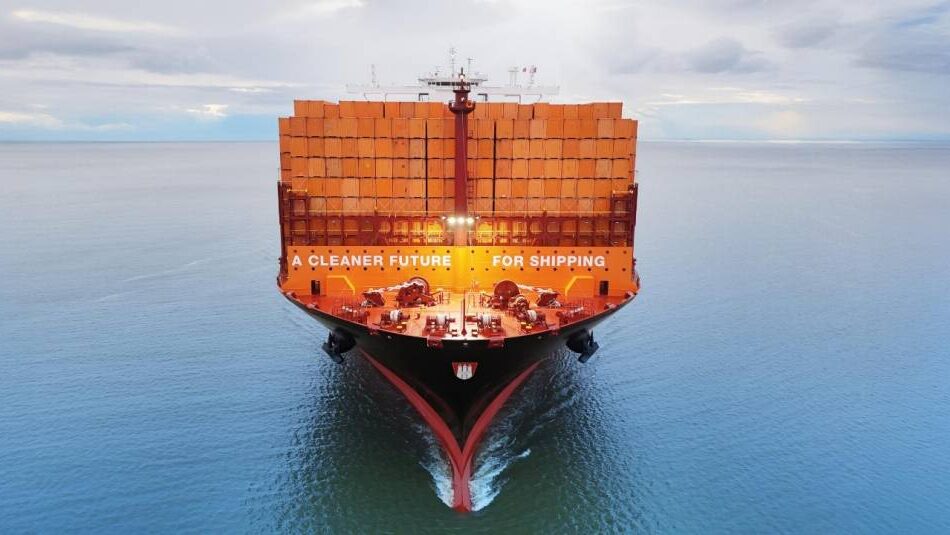
Hapag-Lloyd and Kuehne+Nagel are intensifying their long-standing partnership and are working together for the first time on solutions to reduce the emissions from maritime transport. Under this agreement, Kuehne+Nagel will utilise Hapag-Lloyd’s ‚Ship Green‘ option to reduce the CO₂ footprint of its seafreight transports.
A credible and market-oriented manner
The agreement represents a significant step forward in the collaboration between the two companies. From April to December 2026, approximately 3,300 teu of freight transported on routes between East Asia and Northern Europe will fall under this agreement. By using certified bio-based fuels derived from waste and residues, it is expected that around 2,979 t of CO₂e emissions will be avoided based over the project’s lifecycle.
Danny Smolders, the managing director for global sales at Hapag-Lloyd, pointed out that „we’re proud to elevate our collaboration with Kuehne+Nagel to the next level. With ‚Ship Green‘ we offer a scalable solution that enables our customers to actively reduce their ‚Scope 3‘ emissions. This agreement demonstrates how strong partnerships can be translated into tangible climate protection.“
Paolo Montrone, Kuehne+Nagel’s head of global sea logistics, added that „decarbonising shipping requires transparency, collaboration and economically viable solutions. Through strong partnerships, transparent emission data and enabling ‚Scope 3‘ reductions, we help our customers navigate in a credible and market-oriented manner aimed at accelerating the use of alternative fuels. We look forward to expanding our collaboration with Hapag-Lloyd to realise this.“
Mechanism to reduce emissions
The agreement is based on a book-and-claim mechanism that allows customers to claim verified emission reductions, regardless of the physical fuel allocation to specific ships or routes. Only the emission reductions from biofuels used in Hapag-Lloyd’s fleet will be attributed to Kuehne+Nagel. This model enables scalable climate protection measures and utilises bio-based fuels as a transitional solution.
Both companies have set ambitious climate goals. Hapag-Lloyd aims to achieve a net-zero operational balance for its fleet by 2045, while Kuehne+Nagel is committed to achieving net-zero emissions in its value chain by 2050. Providing sustainable logistics solutions for customers is a key lever in achieving these goals.
Through collaboration and the use of sustainable maritime fuels, as well as the book-and-claim approach, Kuehne+Nagel and Hapag-Lloyd will contribute to transforming the shipping industry into one with a more sustainable energy model.